Nervous Wrek: A Bold Script for Real Projects
As a designer who’s worked with countless typefaces across multiple industries, I’ve come to value fonts that not only look good but also perform well in real-world applications. Nervous Wrek, part of the Script Amp collection, is one such font that demands attention. It’s not just another script—it’s a bold statement, a visual mood, and a tool that can elevate or undermine a design depending on how it’s used.
The First Impression: A Font That Demands Notice
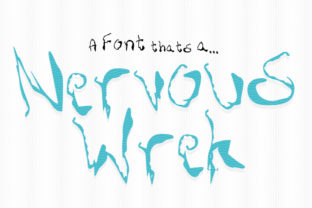
From the moment you see Nervous Wrek, it feels like it’s trying to communicate something urgent. The letters have a jagged, almost chaotic energy, with sharp angles and uneven strokes that suggest movement and emotion. It doesn’t sit quietly on the page; it jumps out, demanding your attention. This isn’t a font for subtle branding or minimalist design. It’s for projects that want to make a strong impression.
The font has a raw, handcrafted feel, which gives it a sense of authenticity. It’s not overly polished, which makes it feel more human and less mechanical. But this also means it requires careful handling—especially when it comes to readability and consistency.
Real-World Use: Where Nervous Wrek Shines and Struggles
In logo design, Nervous Wrek can be a powerful choice if the brand wants to project a sense of urgency, rebellion, or creativity. However, it’s not ideal for all logos. Its irregularity can make it hard to scale down, and its complexity might not translate well into simple icons or symbols. For a logo that needs to work across different sizes and mediums, a more structured script or a sans serif font may be a safer bet.
In packaging design, Nervous Wrek can add a unique flair, especially for niche brands or products targeting younger, edgier audiences. But it’s important to test it on actual mockups. The font’s weight and spacing can affect how it looks on different materials, and its contrast might not hold up well in low-resolution prints.
For web design, Nervous Wrek works best as a heading or a decorative element rather than body text. It adds personality to website headers, banners, or call-to-action buttons. However, using it for long paragraphs will hurt readability, especially on smaller screens. Pairing it with a clean sans serif font can help balance the design without sacrificing visual impact.
When to Use It Carefully: The Pitfalls of a Strong Personality
While Nervous Wrek is great for short phrases, headlines, and decorative accents, it can become overwhelming if overused. Large headlines, in particular, may suffer from poor legibility if the font is not properly spaced or sized. It’s also not the best choice for premium packaging, where a more refined or elegant script might be expected.
Social media graphics are another area where caution is needed. While the font can grab attention in a feed, it may not be suitable for all platforms or audiences. Some users may find it too aggressive or difficult to read quickly. Always test it in context before finalizing a design.
Supporting text, such as captions or footnotes, is another place where Nervous Wrek may not perform well. Its irregular structure can create visual noise, making the text harder to follow. In these cases, a simpler typeface will always be more effective.
Readability, Hierarchy, and Brand Consistency
One of the biggest challenges with Nervous Wrek is maintaining consistent hierarchy. Its dynamic shape and varying stroke weights can make it hard to control how it scales in different sizes. This can lead to inconsistencies in a brand’s visual language, especially if the font is used across multiple touchpoints.
For brand identity, Nervous Wrek can be a strong asset if used strategically. It can serve as a signature font for certain elements, like taglines or special promotions. But it should never be the sole typeface in a brand’s system. A well-rounded typography strategy requires balance, and Nervous Wrek should be paired with other fonts that complement its energy without clashing.
Audience trust and professionalism are also factors to consider. While the font’s uniqueness can be a strength, it can also come across as unrefined or unprofessional in certain contexts. It’s important to align the font’s tone with the brand’s overall message and target audience.
Practical Designer Notes: Testing and Pairing
Before using Nervous Wrek in any project, I recommend testing it in black and white to see how it holds up without color. Sometimes, the font’s texture becomes more apparent in monochrome, which can affect how it reads in different settings.
Check small-size readability. If the font becomes too messy or unclear at 12pt or smaller, it’s not suitable for body text or detailed labels. Try it on real mockups—whether it’s a business card, a poster, or a digital ad—to get a true sense of how it performs in the real world.
Compare uppercase and lowercase versions. Nervous Wrek’s lowercase letters often have a more cohesive structure, while the uppercase can be more erratic. This can affect how it looks in titles or headings.
Review spacing carefully. The font’s irregularity can lead to uneven letter spacing, which may require manual adjustments to ensure it looks balanced and professional.
Test it beside other font styles—serif, sans serif, script, handwritten, and display fonts—to see how it interacts. A good font pairing can enhance the overall design, while a bad one can create visual conflict.
Finally, confirm commercial licensing before using Nervous Wrek in client or business projects. Many premium fonts come with specific usage rights, and using them incorrectly can lead to legal issues.
Conclusion: A Creative Choice for the Right Project
Nervous Wrek is not a font for everyone. It’s a bold, expressive typeface that works best in the right context. For designers looking to add a sense of urgency, creativity, or raw energy to their work, it can be a valuable tool. But it requires thoughtful application, careful testing, and a clear understanding of its strengths and limitations.
If you’re working on a project that benefits from a strong, unconventional visual voice, Nervous Wrek could be the perfect fit. Just remember: the best fonts don’t just look good—they serve the design, the brand, and the audience.